
Business activity, financial ratios, and purification: why halal investing takes more than checking what a company sells
Every Muslim investor eventually asks the same question before buying a stock: "Is it halal?" It is an important question, but one that cannot be answered simply by looking at a company's name, its popularity, or even the products it sells. A company may produce goods that are entirely permissible, yet still fail to meet recognized Shariah standards because of the way it finances its operations or earns part of its income. To help Muslim investors navigate these complexities, Shariah scholars have developed structured screening methodologies for assessing whether an investment is permissible. Although the details vary slightly across different standards, they are all built around three fundamental tests. Understanding these tests will help you appreciate how halal stock screening works and why it goes far beyond surface-level observations.
The first and most obvious question is: What does the company actually do? Before examining a company's financial statements or calculating any ratios, Shariah screening begins by assessing the nature of its core business. If the company's primary activities involve businesses that are prohibited in Islam, the screening process ends there. No matter how profitable or successful the company may be, its shares cannot be considered Shariah-compliant. Examples include businesses whose core activities involve conventional banking, conventional insurance, gambling, alcohol production or distribution, adult entertainment, interest-based lending or any other activities that clearly violate Islamic principles. By contrast, companies operating in sectors such as agriculture, manufacturing, healthcare, telecommunications, technology, construction, and consumer goods generally pass this initial stage because their underlying business activities are permissible. Passing this first test, however, does not automatically make a stock halal. It simply means the company is eligible to proceed to the next stage of the screening process.
Once a company's business activities have been found to be permissible, the next step is to examine its financial structure. This is where many investors are surprised. A company may manufacture halal products and provide valuable services, yet still fail Shariah screening because it relies too heavily on conventional interest-based financing or earns too much income from non-permissible sources. Depending on the recognised screening methodology being applied, analysts assess factors such as the company's interest-bearing debt, interest income, cash held in interest-bearing accounts, certain liquidity measures and other relevant financial indicators. These figures are then compared with established Shariah thresholds. If the company exceeds those thresholds, its shares may no longer qualify as Shariah-compliant, even though the underlying business itself remains permissible. This is why halal investing requires looking beyond products and profits to understand how a company manages its finances.
Suppose a company successfully passes both the business activity and financial screening tests. Does that mean every dividend received by shareholders is automatically halal? Not necessarily. Even companies that satisfy recognised Shariah screening standards may occasionally earn a small amount of income from non-permissible sources, such as interest earned on bank deposits or other incidental receipts. Where that income remains within the accepted thresholds, the company may still qualify as Shariah-compliant. However, shareholders are generally expected to purify the corresponding portion of any dividends they receive by removing that amount from their wealth and giving it away. Purification does not make prohibited income permissible. Rather, it ensures that investors do not personally benefit from the portion of their returns that is linked to non-permissible sources.
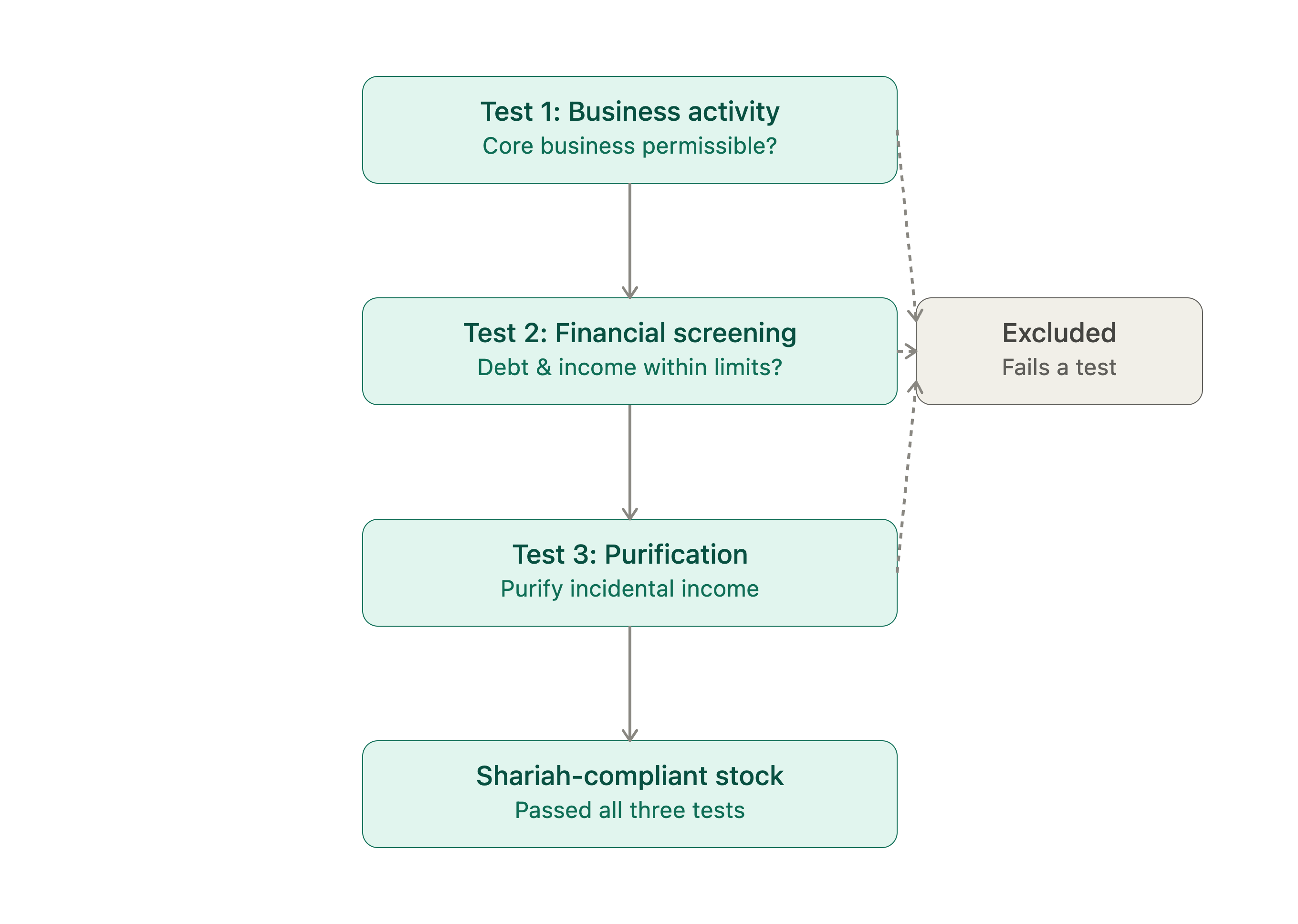
These three tests work together as a comprehensive framework for halal investing. Passing one test does not guarantee that a company will pass the others. A pharmaceutical company, for example, may manufacture life-saving medicines yet rely heavily on conventional bank loans that exceed recognised Shariah thresholds. A manufacturing company may have very little debt but earn too much income from non-permissible investments. Another company may satisfy every screening requirement today but lose its compliance status next year after acquiring a non-compliant business or significantly increasing its conventional borrowing. This is why responsible halal investing cannot be based on assumptions or hearsay. Every company must be assessed carefully and systematically using recognised Shariah methodologies.
One of the most common mistakes investors make is assuming that once a stock has been screened, the work is done. In reality, companies are constantly changing. They publish new financial statements, raise additional capital, restructure their operations and expand into new areas of business. These developments can affect both their financial ratios and the nature of their business activities. A stock that qualified as Shariah-compliant last year may not qualify today. Responsible Muslim investors therefore review their portfolios regularly to ensure that their investments continue to meet recognised Shariah standards.
Applying these three tests manually requires reviewing lengthy annual reports, interpreting financial statements, calculating screening ratios and understanding recognised Shariah standards. For most investors, this process is both time-consuming and technically demanding. That is where Qistal adds value. It screens Nigerian listed companies using recognised Shariah screening methodologies and presents the results in a clear and accessible format. Investors can verify whether a company satisfies the required criteria, understand the reasons behind its compliance status and stay informed whenever that status changes. Instead of spending hours analysing financial statements and regulatory filings, investors can focus on making informed decisions with greater confidence.
Halal investing is not built on assumptions or popular opinion. It is built on careful analysis, recognised standards and a sincere commitment to ensuring that our wealth is earned in a manner that pleases Allah. Before investing in any stock, every Muslim should ask three essential questions. Is the company's core business permissible? Does its financial structure satisfy recognised Shariah screening requirements? If dividend purification applies, do I understand how to fulfil that responsibility? These three tests form the foundation of responsible halal investing. The more diligently we apply them, the greater our confidence that our investments reflect not only sound financial judgment but also our commitment to Islamic values. Because in the end, successful investing is measured not only by the returns we earn, but by the integrity with which we earn them.